
Finish Carpentry vs Rough Carpentry: What's the Difference?
- Partner Crew Rated 5.0 on Google
- Free Estimates
- Serving MA, NH & CT
Get Your Free Estimate
Tell us what you need — we'll get back to you fast.
- Free, no-obligation estimates
- Fast reply by email
- Clean, precise finish work
- Homes & businesses in MA, NH and CT
The Short Answer
Published November 6, 2026 · Finish Carpentry Near Me
Rough carpentry is the structural framing that gets covered up: wall studs, floor joists, rafters, headers and sheathing. Finish carpentry is the visible woodwork installed after the walls are closed: trim, interior doors, stair treads and railings, cabinets and built-ins. Rough work is built to carry loads; finish work is built to be looked at, so it is cut and fitted far more precisely.
Most homeowners only need to know the difference when they plan a project and wonder who to call. Here is how the two trades compare, what one has to leave ready for the other, and why a frame that is out of line shows up later in the trim.
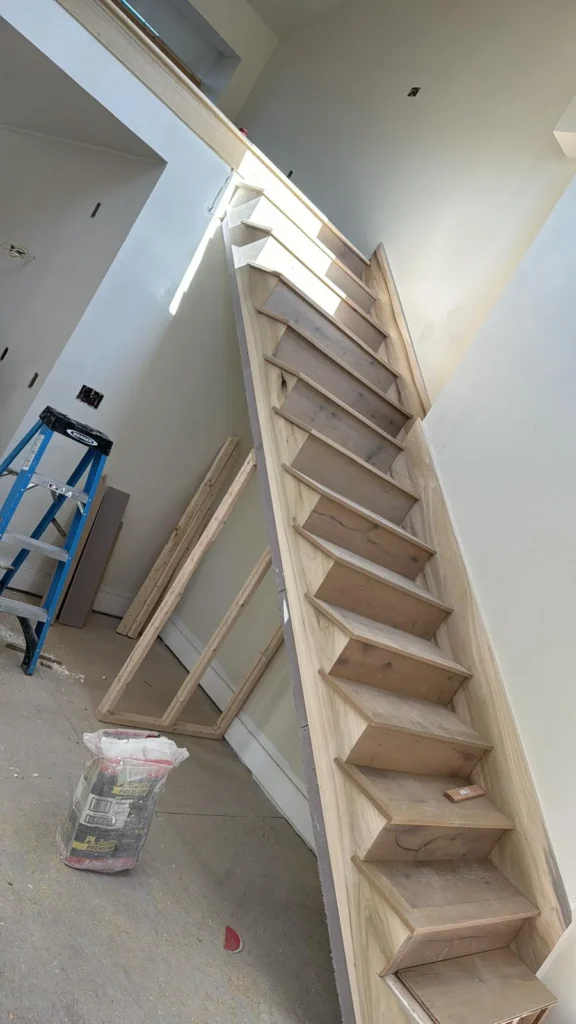
Rough and Finish Carpentry, Side by Side
What rough carpentry covers
Rough carpentry builds the structure of the house: wall studs, floor joists, rafters, the headers over doors and windows, stair stringers and the plywood sheathing that ties it all together. It is built to carry weight and hold the house square, and almost all of it disappears behind drywall, flooring and siding. Framing lumber is not chosen for looks. A knot or a rough edge does not matter as long as the piece is strong and in the right place.
What finish carpentry covers
Finish carpentry starts once the walls are closed. It is the woodwork you see every day: baseboards, crown molding, door and window casing, interior doors, wainscoting, stair treads and railings, cabinets and built-ins. The material is chosen for how it looks and how it takes paint or stain, and every cut stays in view. Our finish carpentry services page lists everything that side of the work includes.
How the two trades compare
- Purpose: rough work holds the house up; finish work is what the room looks like.
- Accuracy: a small difference that is fine inside a wall becomes a visible gap in a miter or an uneven reveal around a door.
- Material: framing lumber and sheathing on one side; trim stock, hardwood, MDF, plywood and cabinet boxes on the other.
- Tools: framing nailers and circular saws for rough work; miter saws, coping saws, finish nailers, planes and scribing tools for finish work.
- Timing: rough carpentry is one of the first stages of a project; finish carpentry is one of the last.
The hand-off: what the framing has to leave ready
Good finish work depends on a few things the framing stage has to get right before the drywall goes up:
- Rough openings for doors and windows that are the right size, plumb and square, so a prehung door can be set without fighting the frame.
- Blocking: extra pieces of wood between the studs wherever something heavy will hang, like upper cabinets, stair handrail brackets, floating shelves or a wall-mounted TV. Once the walls are closed, adding it means opening drywall.
- Stair framing with stringers cut evenly, so every step comes out the same height.
- Flat, straight walls where long runs of cabinets, paneling or built-ins will go.
If you are renovating, it pays to walk the house with your finish carpenter before insulation and drywall, while those details can still be fixed in minutes instead of days.
How the frame shows up in the trim
When something is off in the framing, the finish carpenter is the one who finds it. A wall out of plumb makes a door drift open on its own and leaves the casing reveal wide at the top and thin at the bottom. A bowed stud pushes the drywall out and leaves a gap behind a straight baseboard. A floor out of level means cabinets have to be shimmed so the countertop sits flat. A skilled finish carpenter can scribe, shim and plane to hide most of this, but a door opening that is badly out of square sometimes has to be reframed before it can be trimmed well.
Which one does your project need?
- Mostly rough carpentry: removing or moving a wall, adding a room, fixing a sagging floor, replacing rotted sills or framing a new staircase. Structural work like this often needs a permit, so check with your town’s building department before anything starts.
- Mostly finish carpentry: new trim or crown molding, replacing interior doors, wainscoting, built-ins, cabinet installation, or new treads and railings on an existing staircase.
- Both: opening a new doorway, finishing a basement or an attic room, or a kitchen remodel that moves walls. The framing comes first and the finish work follows, so ask early who handles each part and how they will coordinate.
Why It Matters in New England Homes
Many New England houses were framed long before today’s standard lumber sizes. In an older home a 2×4 can measure close to a full two by four inches, walls may be plaster over wood lath instead of drywall, and wall thickness can change from one room to the next. That changes the depth of door jambs, how casing sits against the wall and how new cabinets meet old walls, so the finish carpenter measures every opening instead of assuming.
New framing moves too. Lumber keeps drying after the house is closed in, and the first heating season of a dry New England winter is when small gaps and nail pops tend to show up. Installing trim after the framing and drywall have had time to dry, and letting the trim acclimate in the house first, keeps most of that movement out of the finished work.
Questions to Ask Before You Hire
A good finish carpenter will be glad to answer these:
- If we open a wall or a doorway, who frames it and who trims it?
- Who checks that the rough openings are plumb and square before the doors go in?
- Is there blocking in the walls for the cabinets, handrail and shelves, or should it go in before drywall?
- If the walls or floors are out of line, how will you handle it in the trim?
- What has to be finished by the other trades before you start?
Want a second opinion on your project? See our Finish Carpentry Services or send the details through the estimate form. Estimates are free and we reply by email.
Why Homeowners Choose Us
Precision Craftsmanship
Every detail matters.
Fast & Reliable Service
We show up on time.
Clean & Professional
No mess left behind.
Custom Solutions
Built to match your vision.
100% Satisfaction Focused
The job is done when you are happy with it.
Finish Carpentry Services
Trim & Baseboards
Clean, precise trim and baseboard installation to elevate your interior finish.
Door Installation
Professional door and frame installation with perfect alignment and finish.
Crown Molding
Add elegance and value to your home with detailed crown molding work.
Custom Woodwork
Tailored wood solutions designed to match your style and space perfectly.
Wainscoting & Paneling
Classic wall paneling and wainscoting that add depth and character to any room.
Cabinet Installation
Cabinets set level, secured and trimmed for a clean, built-in look.


Your Free Estimate in Three Simple Steps
1. Tell Us About Your Project
Fill out the short form with the service you need and a few details about the space.
2. Get Your Free Estimate
We review your request and reply by email with a custom estimate for your project.
3. We Do the Work
Once you approve, we schedule the job and complete it with clean, precise finish work.
Questions, Answered
Is framing considered rough carpentry?
Yes. Framing walls, floors and roofs is the core of rough carpentry, along with headers, stair stringers, blocking and sheathing. It is called rough because it gets covered up, not because it is careless: a good frame is what lets the finish work look straight.
Can the same carpenter do rough and finish work?
Some carpenters do both, especially on smaller jobs like opening a doorway or framing a closet and then trimming it. On larger projects they are often separate crews. Either way, ask which parts of your project the carpenter will handle and who checks the framing before the finish work starts.
Is building stairs rough or finish carpentry?
Both. The stringers and framing that hold the stairs up are rough carpentry. The treads, risers, skirt boards, newel posts and railings you see and walk on are finish carpentry, and they can only be as even as the framing under them.
Is cabinet installation rough or finish carpentry?
Finish carpentry. Cabinets have to be set level, plumb and tight to the wall, with fillers and trim to finish the look. The rough part is making sure there is solid framing or blocking behind the wall where they will be fastened.
Why does new trim sometimes open up even when it was installed well?
Usually the house is moving underneath it. New framing lumber keeps drying, and dry winter air shrinks the trim itself. Most of these gaps are small and can be touched up after the first heating season, and careful joinery keeps them to a minimum.
How much does finish carpentry cost compared to rough carpentry?
It depends on the project: the rooms, the materials and the condition of the framing behind the walls. The way to know for your home is a free estimate, where the carpenter sees the space and tells you exactly what is included.
What Homeowners Say About Our Partner Crew
Every project is installed by our partner crew, RD Finish Carpentry. These are their Google reviews · see all on Google.
 Trustindex verifies that the original source of the review is Google.

 Trustindex verifies that the original source of the review is Google.
 Trustindex verifies that the original source of the review is Google.
 Trustindex verifies that the original source of the review is Google.
 Trustindex verifies that the original source of the review is Google.

Get a Free Quote for Your Finish Carpentry Project
Get Your Free Estimate
Tell us what you need — we'll get back to you fast.